Overview
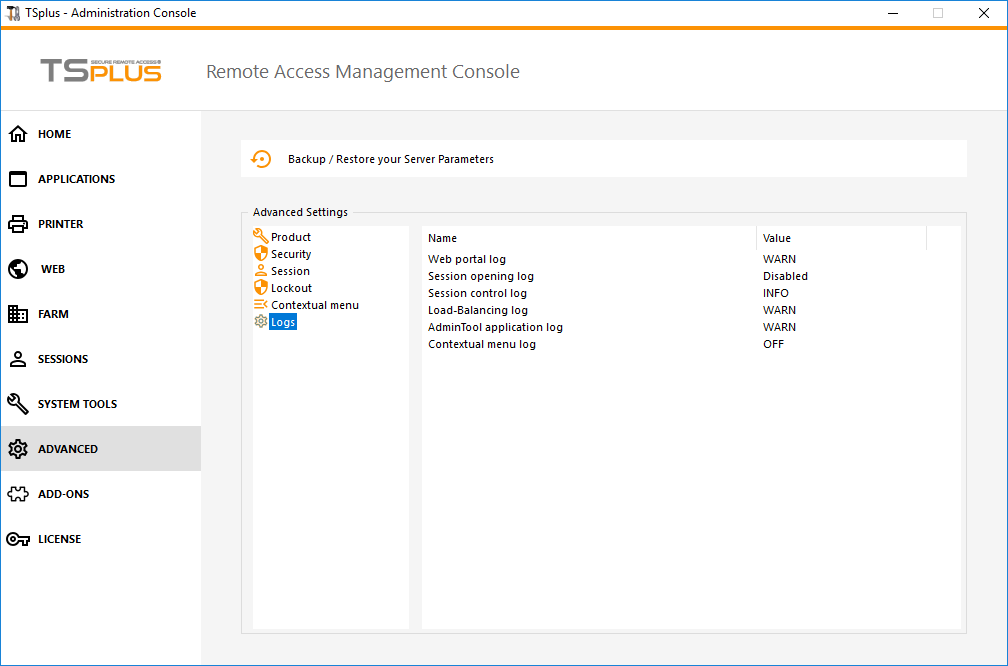
There are 5 types of logs:
The Web Portal log,
The Session Opening log,
The Session control log,
The Load-Balancing log and
The AdminTool application (interface) log.
Log levels correspond to different components, our support team will tell you what value to put according to the problem encountered.
Here are the different log file names and locations:
Web Portal log: “C:\Program Files (x86)\TSplus\Clients\www\cgi-bin\hb.log”
Session Opening log: “C:\wsession\trace”
Session control log: “C:\Program Files (x86)\TSplus\UserDesktop\files\APSC.log”
Load Balancing log: “C:\Program Files (x86)\TSplus\UserDesktop\files\svcenterprise.log”
AdminTool application log: “C:\Program Files (x86)\TSplus\UserDesktop\files\AdminTool.log”
RDS-Knight / TSplus Advanced Security: “C:\Program Files (x86)\TSplus-Security\logs”
You can enable the logs for Connection Client on the client side by adding the following registry key:
[HKEY_LOCAL_MACHINE\SOFTWARE\Digital River\ConnectionClient] “Debug”=“true”
The logs are located in C:\Users<Username>\RDP6\logs directory if installation is per user or in C:\Program Files (x86)\Connection Client\RDP6\logs directory if installation is for all users.

There are 5 types of logs:
The Web Portal log,
The Session Opening log,
The Session control log,
The Load-Balancing log and
The AdminTool application (interface) log.
Log levels correspond to different components, our support team will tell you what value to put according to the problem encountered.
Here are the different log file names and locations:
Web Portal log: “C:\Program Files (x86)\TSplus\Clients\www\cgi-bin\hb.log”
Session Opening log: “C:\wsession\trace”
Session control log: “C:\Program Files (x86)\TSplus\UserDesktop\files\APSC.log”
Load Balancing log: “C:\Program Files (x86)\TSplus\UserDesktop\files\svcenterprise.log”
AdminTool application log: “C:\Program Files (x86)\TSplus\UserDesktop\files\AdminTool.log”
RDS-Knight / TSplus Advanced Security: “C:\Program Files (x86)\TSplus-Security\logs”

You can enable the logs for Connection Client on the client side by adding the following registry key:
[HKEY_LOCAL_MACHINE\SOFTWARE\Digital River\ConnectionClient] “Debug”=“true”
The logs are located in C:\Users<Username>\RDP6\logs directory if installation is per user or in C:\Program Files (x86)\Connection Client\RDP6\logs directory if installation is for all users.
Overview
Go to the “License” tab Click on the “Enable Troubleshooting Mode” button.

Reproduce your problem, then click on the “Export logs (for support)” button to send the logs to the support team by email.


The format of the file to send is .zip.logs files and is protected by the password “password”.